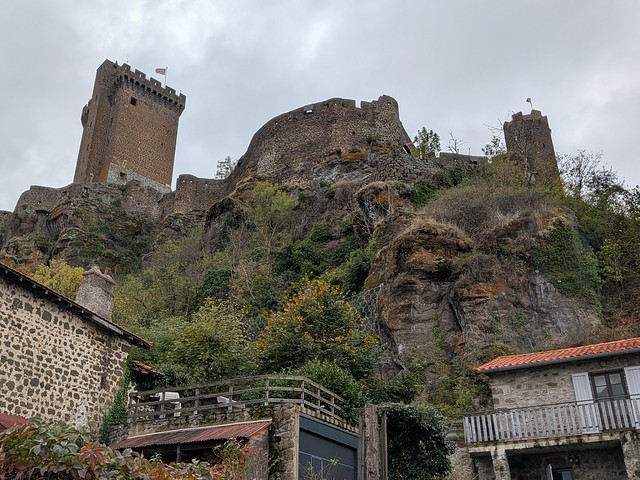
Clermont-Ferrand is home to Michelin tires. The company quadrupled the population of the town in less than a century, fueled by rubber from French Indochina. At their height, the company had close to 30,000 employees in the area. Today, they operate with just one third of the peak number. The trams in Clermont-Ferrand run on rubber tires instead of steel wheels.
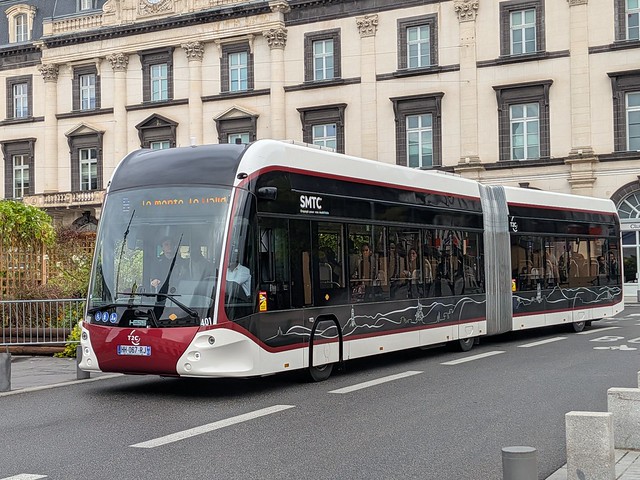
During Covid I got friends together to read Capital and Ideology by the French economist Thomas Piketty. I don't think I began to internalize his take on French history until this trip. Clermont was the seat of the clergy while MontFerrand was the realm of the nobility. In fact, Montferrand is one of the earliest bastide towns (planned village/towns founded by nobility in the 13th and 14th centuries, as supposedly organically grown). It is rather well preserved, with a number of half timber houses, which I had previously associated with only Alsatian and Normandy tourist villages/towns. They are in fact very common all over Europe.
John has been dreaming of the summit of Puy de Dome at 1485 meters elevation [just Puy "Dome" (pwee-dohm) to the locals]. But the weather did not cooperate on Tuesday or Wednesday, so we set out on Thursday morning, our last full day in CF, expecting wind, clouds, and rain. We chose a less traveled route; taking the bus to the Parking des Goules bus stop north of Orcine, halfway to the Vulcania Amusement Park. From there we headed to the Puy de Pariou Volcano Crater. The trail was beautiful.


Everything changed as we came out of the forest and then emerged at the lip of Pariou rater. We were in the clouds, and the wind nearly blew us off the trail. We stopped to put on rainpants, scarves, and gloves.


On the descent from Puy de Pariou there were some good views down to Clermont in the valley, below the clouds


At the next signposted crossroads we took the Chemin des Chevres, which means "Goat Path" in French, but in reality it's a very well maintained trail with long sections of wooden steps.


The clouds lessened for a minute and I believe this is a photo of the summit of Puy de Dome.

One last look to Clermont below. and then into the clouds.

Almost at the summit, we pop out near the Panoramic Train tracks and walk on the parallel road up to the Temple of Mercury, shrouded in clouds


The Gallo-Roman Temple of Mercury, built around 140 AD,


Then it's an easy walk down, down, down to the Orcines Gare du Panoramique des Dômes bus stop and home. Cold beer hello!!


Clermont is very proud of its two city center churches, the 12th-century Romanesque UNESCO World Heritage Basilica of Notre-Dame du Port ...


... and the Cathedral with its rose windows and stained-glass. Second below is the church organ and rose window. Third below is the Genesis Stained-Glass Window. And fourth below is the Legend of Saint Zita.


Just about everyday, we walked by the Egyptian Revival Style Mosaics on the Pharmacie L. Gros corner building from 1922. Super cool!


One day we walk over to Clermont's other half, Montferrand, the home of everything Michelin; rubber tires to guide books to ratings. Most of our walk was in the heart of the medieval Montferrand, with a few remnants of its city walls (1st below).


Église Notre-Dame de Montferrand

MONTFERRAND TELEGRAPHE + TELEPHONE + POSTES (1938)

View from our Apartment Window
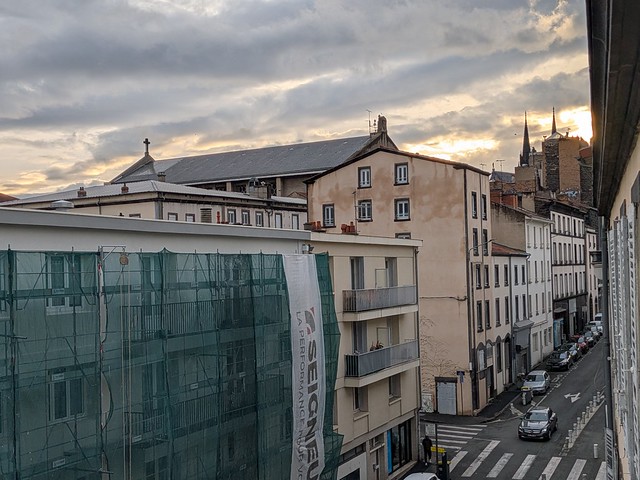
Below are some shots from our walks around Clermont-Ferrand.