I've been playing around with Google Spreadsheets. To see a Google Spreadsheet showing our Japan Trip expenses, click here.
or look at the embedded version below.
Saturday, January 13, 2007

Thursday, January 11, 2007
Japan 2006 - Part 3 - Tokyo - Asakusa to Shinjuku
Oct, 03 2006 - Tokyo
Plan for the day: Asakusa => Sumida River Boat Cruise => Imperial Palace => TBD
Go straight to photos.
Up at 7:30AM and out the door just after 8. Walked north a bit over to the Sumida River where we found a friendly coffee shop, Doutor, a well-known Japanese chain, where we had 2 Large Mochas and 2 pastries each for 13K Yen total ($10US). The Doutor was quiet and efficient as all the patrons, except for us, seemed to be individuals; that is, there by themselves. We also saw first-hand the phenomena of using one's cell phone to “save” a table.
Then over for a short walk along the Sumida River bank. Located the ferry dock for the river cruise we would take later in the morning.
Walked down to the Mitsubishi Bank (like the auto company). They do NOT take foreign ATM cards (as we suspected but the Hotel management told us to go there anyway) but the security guard immediately gave us a nice map that showed the location of 2 nearby Post Offices that have ATMs for foreign networks (Plus, etc). I guess Mitsubishi Bank must get lots of foreign visitors. Efficient.
So over to the Post Office near the subway station and withdrew 50000 yen and back to the hotel to pay the 22000 bill – 11K per night for a double.
Finally we are out for the day. First we toured all around the nearby Sensoji Temple. The monks were chanting. Many tourists were in and around the temple complex and the famous Nakamise Souvenir Arcade. John took many photos and Sun-Ling bought a printed cotton tenugui (hand towel) for later framing from Keiji and Chihiro Kawakami for 1800 Yen.
Tourists taking a modern rickshaw to see the sites in Asakusa district
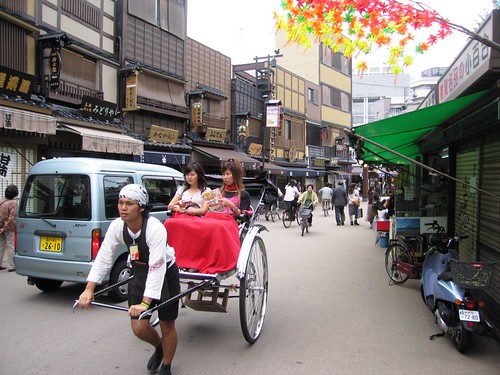
After more walking past the craft stalls with the painted doors (see photos) we barely made it over to catch the 11:30 ferry from Asakusa to Hinode pier – 1060 each - and they collected the tickets at exit so no souvenir.
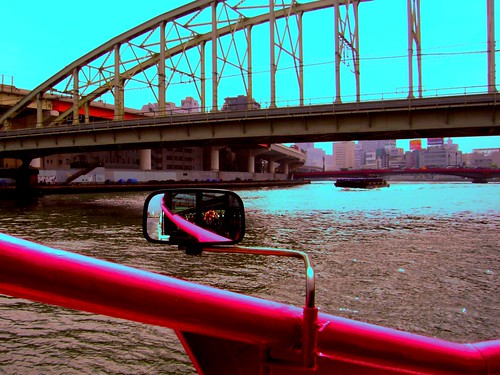
A fine ride. Forty-five minutes or so under the 10+ bridges, each with a distinctive architecture. The boat was 2 levels and almost full including one load of school children who were lively but well behaved; that is, they bobbed up and down but stayed at their seats with no fighting.
Along the bank of the Sumida River there was a significant homeless encampment. Lots of blue tarps, or real tents, laundry, and other signs of an “organized” or “long-tern” or “semi-legal” or “tolerated” encampment. The best spots were under overpasses or elevated highways that ran along the river side of the bank. Riverview + roof. The river bank had a nicely paved, wide, riverwalk/path/quay on both sides – a great place to camp. Sign me up.
Sun-Ling took control of the camera, stood near the bow, and took photos of each bridge while John hung out in a seat. Just before we pulled into Hinode Pier, we had great views to the Rainbow Bridge and the Odaiba area with the great globe of the Fuji TV building. Got off at the Hinode Pier and followed the well-marked signs to the nearby JR station and rode 5 stops to Tokyo Station using our Rail Pass.
Sumida River
Tokyo Station is very large as it is a Terminal or Main station for Tokyo and the North/South Shinkanshan. We finally made our way to the North Exit with its red brick façade and early 20th century European stylings.
We then followed the wide main drag to the Imperial Palace. It was much bigger; much, much bigger, than expected. With inner and outer moats, massive gates, wide gravel paths, huge gardens, and a tremendously large area not open to the public. It must have its own circle subway line – just joking.
Made a vending machine stop. Our first in Japan. Sun-Ling bought an ice-cream and I bought a small iced tea.
Walked through the public East Gardens. Set a spell, rested and plotted our next move which turned out to be catching the subway to Yoyogi Park, home to the Meiji Shrine, the largest and most important Shinto Shrine in Japan. Not to mention it is next to some of the most interesting shopping districts. Takeshita Dori for young Punks, Goths, Lolitas, and Hipsters. Omotesando Street is the Champs-Elysee of Tokyo with cathedrals to Gucci, Louis Vitton, Max, etc.
The day started to get interesting. First, Takeshita Dori. Teenage girls wearing very outrageous stuff. Mostly what I think is called the “Lolita” look – they dress like 4 or 5 year old girls. Of course the “normal” schoolgirl apparel in Japan is “sailor suit” or “white shirt and plaid skirt” which could be strange or outrageous if worn in public in the USA. Very busy. Very young. Sun-Ling said she felt old. “Finally” said John.
Then over to Meiji Shrine, past the 3-piece rock bank busking on the pavement. Yoyogi Park is very wooded and green. Took some photos and video. Many western and Japanese tourists about. White lanterns. Wooden wish cards.
Then back down Omotesando Street. Bought a gold lacquer box at Oriental Bazaar for 300 yen. Ate dinner at nearby Brown Rice Café. Each had menu of the day for 1060 each. It’s 1000 plus 6 percent tax. Get it? Very tasty, but no alcohol served. Hmm.
Walked through adjoining neighborhood of trendy shops, boutiques, and restaurants. Got a little lost but straightened out.
3-wheeled Honda Gyro Canopy on Omotesando Street.
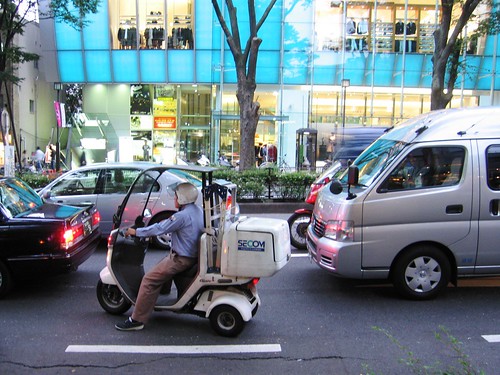
Then back to JR line and rode 2 stops north to Shinjuku district and headed east to the “entertainment” district – lots of neon – and many young people. Used to be the Red Light District but now is a pedestrian mall with lots of PG entertainment.
Shinjuku at night.
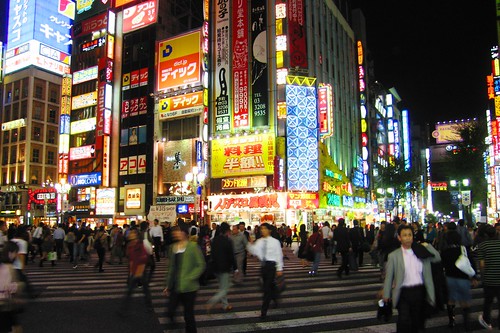
After lots of walking around we decided to head back to Asakusa for a “dinner” of drinks and snacks at the famous Kamiya Bar. After a 30 minute journey back, we arrived at a “closed’ Kamiya Bar. What kind of bar is closed at 9PM? Maybe it’s closed every Tuesday.
So after failing to find a noodle shop recommended by Frommers, we ate at TNT Tempura Shop on the main drag. We had briefly checked it out the night before. It’s a small shop, probably a chain, with young folks running the show. Three booths, a 10-seat bar plus kitchen. We had 2 Sapporo drafts (Nama Beer) and 2 veggie tempuras plates for 1890 total. The tempura was great: one each of lotus root, pumpkin, yam-like root, egg plant, and mushroom clump, all in a bowl of rice. Plus a cold tofu dish. Back to hotel passing a lively indoor soccer match on the way. Crash.
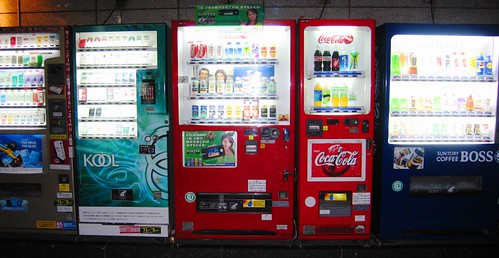
Final shot. The famous Japanese vending machines.
Plan for the day: Asakusa => Sumida River Boat Cruise => Imperial Palace => TBD
Go straight to photos.
Up at 7:30AM and out the door just after 8. Walked north a bit over to the Sumida River where we found a friendly coffee shop, Doutor, a well-known Japanese chain, where we had 2 Large Mochas and 2 pastries each for 13K Yen total ($10US). The Doutor was quiet and efficient as all the patrons, except for us, seemed to be individuals; that is, there by themselves. We also saw first-hand the phenomena of using one's cell phone to “save” a table.
Then over for a short walk along the Sumida River bank. Located the ferry dock for the river cruise we would take later in the morning.
Walked down to the Mitsubishi Bank (like the auto company). They do NOT take foreign ATM cards (as we suspected but the Hotel management told us to go there anyway) but the security guard immediately gave us a nice map that showed the location of 2 nearby Post Offices that have ATMs for foreign networks (Plus, etc). I guess Mitsubishi Bank must get lots of foreign visitors. Efficient.
So over to the Post Office near the subway station and withdrew 50000 yen and back to the hotel to pay the 22000 bill – 11K per night for a double.
Finally we are out for the day. First we toured all around the nearby Sensoji Temple. The monks were chanting. Many tourists were in and around the temple complex and the famous Nakamise Souvenir Arcade. John took many photos and Sun-Ling bought a printed cotton tenugui (hand towel) for later framing from Keiji and Chihiro Kawakami for 1800 Yen.
Tourists taking a modern rickshaw to see the sites in Asakusa district
After more walking past the craft stalls with the painted doors (see photos) we barely made it over to catch the 11:30 ferry from Asakusa to Hinode pier – 1060 each - and they collected the tickets at exit so no souvenir.
A fine ride. Forty-five minutes or so under the 10+ bridges, each with a distinctive architecture. The boat was 2 levels and almost full including one load of school children who were lively but well behaved; that is, they bobbed up and down but stayed at their seats with no fighting.
Along the bank of the Sumida River there was a significant homeless encampment. Lots of blue tarps, or real tents, laundry, and other signs of an “organized” or “long-tern” or “semi-legal” or “tolerated” encampment. The best spots were under overpasses or elevated highways that ran along the river side of the bank. Riverview + roof. The river bank had a nicely paved, wide, riverwalk/path/quay on both sides – a great place to camp. Sign me up.
Sun-Ling took control of the camera, stood near the bow, and took photos of each bridge while John hung out in a seat. Just before we pulled into Hinode Pier, we had great views to the Rainbow Bridge and the Odaiba area with the great globe of the Fuji TV building. Got off at the Hinode Pier and followed the well-marked signs to the nearby JR station and rode 5 stops to Tokyo Station using our Rail Pass.
Sumida River
Tokyo Station is very large as it is a Terminal or Main station for Tokyo and the North/South Shinkanshan. We finally made our way to the North Exit with its red brick façade and early 20th century European stylings.
We then followed the wide main drag to the Imperial Palace. It was much bigger; much, much bigger, than expected. With inner and outer moats, massive gates, wide gravel paths, huge gardens, and a tremendously large area not open to the public. It must have its own circle subway line – just joking.
Made a vending machine stop. Our first in Japan. Sun-Ling bought an ice-cream and I bought a small iced tea.
Walked through the public East Gardens. Set a spell, rested and plotted our next move which turned out to be catching the subway to Yoyogi Park, home to the Meiji Shrine, the largest and most important Shinto Shrine in Japan. Not to mention it is next to some of the most interesting shopping districts. Takeshita Dori for young Punks, Goths, Lolitas, and Hipsters. Omotesando Street is the Champs-Elysee of Tokyo with cathedrals to Gucci, Louis Vitton, Max, etc.
The day started to get interesting. First, Takeshita Dori. Teenage girls wearing very outrageous stuff. Mostly what I think is called the “Lolita” look – they dress like 4 or 5 year old girls. Of course the “normal” schoolgirl apparel in Japan is “sailor suit” or “white shirt and plaid skirt” which could be strange or outrageous if worn in public in the USA. Very busy. Very young. Sun-Ling said she felt old. “Finally” said John.
Then over to Meiji Shrine, past the 3-piece rock bank busking on the pavement. Yoyogi Park is very wooded and green. Took some photos and video. Many western and Japanese tourists about. White lanterns. Wooden wish cards.
Then back down Omotesando Street. Bought a gold lacquer box at Oriental Bazaar for 300 yen. Ate dinner at nearby Brown Rice Café. Each had menu of the day for 1060 each. It’s 1000 plus 6 percent tax. Get it? Very tasty, but no alcohol served. Hmm.
Walked through adjoining neighborhood of trendy shops, boutiques, and restaurants. Got a little lost but straightened out.
3-wheeled Honda Gyro Canopy on Omotesando Street.
Then back to JR line and rode 2 stops north to Shinjuku district and headed east to the “entertainment” district – lots of neon – and many young people. Used to be the Red Light District but now is a pedestrian mall with lots of PG entertainment.
Shinjuku at night.
After lots of walking around we decided to head back to Asakusa for a “dinner” of drinks and snacks at the famous Kamiya Bar. After a 30 minute journey back, we arrived at a “closed’ Kamiya Bar. What kind of bar is closed at 9PM? Maybe it’s closed every Tuesday.
So after failing to find a noodle shop recommended by Frommers, we ate at TNT Tempura Shop on the main drag. We had briefly checked it out the night before. It’s a small shop, probably a chain, with young folks running the show. Three booths, a 10-seat bar plus kitchen. We had 2 Sapporo drafts (Nama Beer) and 2 veggie tempuras plates for 1890 total. The tempura was great: one each of lotus root, pumpkin, yam-like root, egg plant, and mushroom clump, all in a bowl of rice. Plus a cold tofu dish. Back to hotel passing a lively indoor soccer match on the way. Crash.
Final shot. The famous Japanese vending machines.
Tuesday, January 09, 2007
Japan 2006 - Part 2 - Mt. Koya to Tokyo
Oct 2, 2006
Mt. Koya to Tokyo
Mt. Koya to Tokyo
“The food was tasty, the owner gracious, and the beer cold.”
Plan: Morning sightseeing in Mt. Koya and then bullet train to Tokyo where we have a reservation at the Family Hotel Kamogawa in the Asakusa District.
The “maid” knocked on our door at 6:30 AM and returned 5 minutes later to take away the bedding. She came back 10 minutes later with breakfast: tea, miso soup, pickled fruit, seaweed strips, tofu paddy, rice, pickle root, savory seeds to shake on rice, and hunk of boiling tofu in paper pots like last night. I rate the breakfast as fair. A bit too slimy for me. ;-)
7:30: Put on our clothes and headed out to Kondo temple complex where the monks and assorted helpers were setting up for initiation ceremonies that took place over the course of Oct 1, 2, and 3. We sat and watched the last minute preparations: sweeping, banner hanging, and lamp hanging. Then they “closed the doors” -- peaceful -- and we walked back to the Inn. The sun briefly came out. Then into the hot spring bath for a short soak.
We checked out at 9:00 and paid our bill of 23600 Yen, about $200 US, cash only. They stored our bags for us as we had more sites to see. Took some photos of the fish ponds, rain garden, and rooftops. Caught a bus towards the cemetery and rode to the end. It started raining cats and dogs so we ducked into a UCC coffee shop and had a couple a coffees for $3 each.
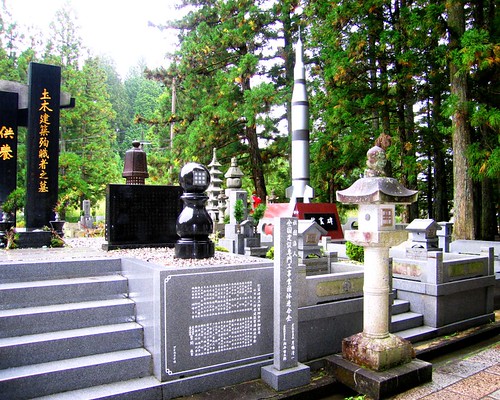
The rain let up and we walked up though the cemetery towards the Kukai Mausoleum, passing the rocket memorial (see photo), many Jizo (statues with red bibs – see photos), the water spirit memorials, etc. While taking photos I almost stepped on a snake. Also we saw either a very small orange/red/black hummingbird or a big fly.
The rocket memorial.
Then, as we were about to cross the sacred bridge, about 50 monks paraded out of the Hall of Lanterns and came down the path towards us. “No photo” motioned the leader to me, so no shots. After passing they arranged themselves into a cube and chanted and bowed in the four directions in front of another pavilion. As it began to rain, they one-by-one grabbed black umbrellas from a nearby stash and sprinted away down the main path. I wish I had good video or photos as these monks looked splendid in their orange and yellow robes with the black umbrellas. I caught a bit of the cube chanting on this video.
We briefly looked in on the Hall of Lanterns and then walked around to its back where the tomb of Kukai is located. You can’t really get close to the tomb so there’s not much to see. It started raining so we sat for a while under the large overhanging eaves on a long, long bench facing the tomb. Over the course of the next 15 minutes or so we watched people walk up and stop to chant or bow or light candles or all three.
The rain let up and we headed back down and attempted to find a north tracking road so we could make a short hike up to the top of Mt. Tenjuki. Found the road and eventually ran into a well marked trail that took us up to the top of Mt Tenjuki at a height of 910 meters above sea level. The summit was gained in less than an hour and marked by a shrine. We descended down the opposite side, walked by a small pond, though the new cemetery, and caught a bus back to town. Tried to find an open convenience store to stock up on provisions, but no luck, so we head back to the Inn, collected our bags, and polished off the rest of our peanuts and tofu.
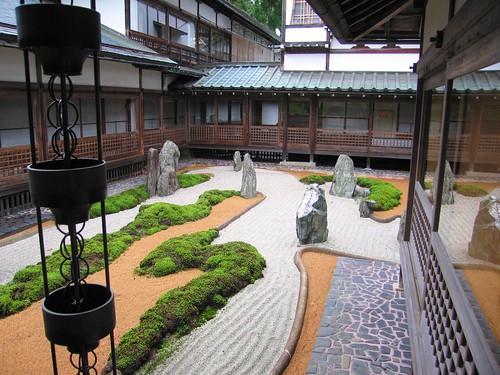
Rock garden (karesansui) at the Fukuchi-in, the temple where we stayed on Mt. Koya.
Next: Return journey to Shin Osaka station and then on the Tokyo: 1:06 bus, 1:30 funicular: 1:42 train to Shin Osaka
As we waited for the funicular I noted that the temperature was 20 C. Also noted that in addition to the cable under the funicular, there was an overhead electric line. Hmm. There was a group of shall we say “active but polite” school boys on the train. There first activity was to try to push open a glass window that would have to curve in order to open – no wonder they are having trouble. They are not as smart as they think they are. ;-)
Arrived at Shin Osaka at 3:22. Transferred to Subway – 270 yen each – and rode 7 stops and caught the Hakari train to Tokyo. Whew! In the Shin Osaka Station we bought some lunch: 1 slice of veggie pizza, 1 egg salad sandwiches, and two pastries - all for 1010 Yen, about 8 dollars.
Some notes on the trip from Shin Osaka to Tokyo:
- We are in Car #6. The configuration is 2 x 3.
- The station announcements are in both Japanese and English.
- Many tunnels. Can feel pressure change in ears.
- Its 6:20 PM and totally dark outside as it is raining.
- This train is fairly full.
- Sun-Ling is studying Tokyo: Our route to the hotel this evening and our itinerary for tomorrow.
- Sun-Ling commented that during peak hours, trains leave Osaka every 10 minutes for Tokyo. What can’t we do that in China. Have trains leave Shanghai for Beijing every 10 minutes during peak hours. [We later found out that in the evenings, the overnight trains from Shanghai to Beijing do leave every 15 minutes or so.]
The train arrived on time at Tokyo Station at 7:13 PM. We transferred (free with Rail pass) to the local JR Circle line and rode 4 stops. The stations were crowded as the rush hour was not yet over, but no worse than Shanghai We then bought 2 tickets at 160 each for Ginza line and rode 3 stops to Asakusa station – the terminal station. Then, a 3 minute walk to the Kamogawa Family Hotel.
Even though it was still raining, almost the entire walk to the hotel was under cover. They had our names and we were installed in room #205 which fronts the street just as we like. It’s a traditional Japanese room with 2 parts, a “sitting” room with low table, fridge, mirror, and cushions, and “sleeping” room with mats, quilts, and closet. It’s about 3 meters by 10 meters. Nice. With tatami mats all round..
Then out to find dinner. We looked for one “cook yourself’ place but it was closed. So we ended up at 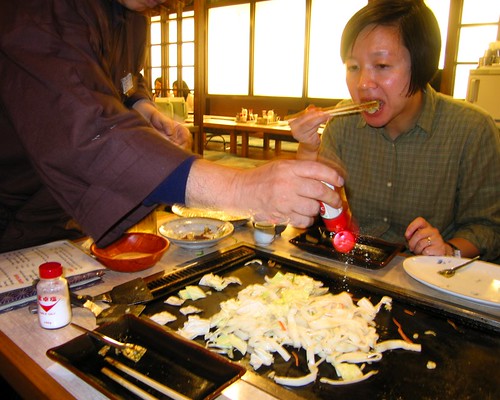
That's all!
To see all of the photos from Oct 02, click here.
Sunday, January 07, 2007
Japan 2006 - Part 1 - Fukuoka and Mt. Koya
Japan 2006
Prologue: From the moment I accepted the job with Intel in Shanghai, both Sun-Ling and I knew it was only a matter of time before we traveled to Japan. The only decisions to be made were when and where. Our first choice ,first week in May 2006, 7-day public holiday in China, turned out to be a “Golden Week” holiday in Japan as well due to the confluence of 3Japanese National Holidays. So we opted for the fist week in October 2006, a Chinese 7-day public holiday, but not a Japanese holiday.
The “where” for us is usually partially determined by the cost of the to-from transportation. Frequent Flier miles are best. We’ve been know to add or delete an entire country based on its FF mile seat availability. We ended up flying into Fukuoka in southern Japan as it is 50% of the cost to fly to Tokyo, but connected to the Bullet Train (Shinkansen) network.
Journal:
30 September
4:30 PM – Pudong Airport - The start of another Golden Week Holiday. We worked Monday through Saturday and now have 7 days off for the National Day Holiday plus Mid Autumn Festival. Mid Autumn Festival is the Chinese equivalent of a Harvest Moon Festival and by chance this year falls during National Day Holidays. We however, will not be in Shanghai, but will spend the 7 days in Japan. Our flight leaves at 6:00 PM so we have plenty of time – hopefully time for a snack. ;-)
Fukuoka, Japan
Japan is one hour ahead of China, so after a 75 minute flight we landed at 8:30 local time. Quickly passed through the short foreigners immigration line and answered 3 questions at Customs.
“Where do you live?”
“Shanghai.”
“Where did you come from?”
“Shanghai.”
“How long will you be here?”
“7 days.”
Wave of hand.
The Citibank ATM was right at the Customs exit just as our research had indicated. We extracted 50,000 Yen with no problem, used the WC, and caught the 8:55 shuttle bus to the Domestic Terminal. 11 minutes. Easily found the subway entrance. Sun-Ling expertly bought 2 tickets after I pointed out the “English” button and we hopped on the subway at 9:25. We rode 3 stops, 1 stop past the Train Station, and then walked about 3 minutes to the JBB Hotel following the excellent directions on their website.
The young lady at the counter spoke English and seemed to be expecting us. She made copies of our passports, took our 6800 Yen (about $50 US), and gave us the key to room #606. The room was very small, but not the smallest ever. The bathroom had a sink, tub/shower (the shower head on flexible hose), western toilet, toothbrushes, toothpaste, and cups. The sink and shower shared the same faucet which swiveled between sink and tub. Nifty idea. There is a western double bed, no closet (2 hooks on the wall), desk, small fridge, TV, hair dryer, mirror, a small stool (no chair), robes, and slippers. Compact.
After check-in, we immediately headed back out and walked 10 minutes to the train station – past a Lawsons – and after a few inqueries found the right Japan Rail desk to convert our rail pass voucher to an actual 7-day Japan Rail Pass. The yong man behind the counter was quite nice, spoke enough English, made copies of our passports, and gave us our Rail Passes. Then we made 3 “free” train reservations: the next day from Fukuoka (Hakata Station) to Shin Osaka, the day after tomorrow from Shin Osaka to Tokyo, and the final day from Kyoto to Hakata Station. Excellent!
Then we walked west from the station to the Canal District. Saw the local “food stalls” and briefly toured the “red light district”. Young ladies sat on the balconies with a red light florescent light turned on. Wondered back to the hotel by way of the local temple and museum which were closed. The canal area was nice – clear water – and we saw one homeless guy sleeping on a bench. He had a nice quilt, pillow, and looked quite comfy. Arrived back a JBB hotel around 11:15. Ate some of our food stash, showered, relaxed, and crashed.
Impressions of Fukuoka:
Compact, clean, busy, but not crowded.
Easy to get around with an over supply of taxis. Lots of idle taxis near the train station.
Small folding bicycles are popular – just like China. Now I know where they come from. ;-)
Some folks were quite stylishly dressed
SLHOTD: Canal walk
Oct 1, 2006 Fukuoka to Mt Koya
Plan: Train from Fukuoka to Mt. Koya where we will stay one night at a Buddhist Monastery. Mt Koya or Koyasan is associated with Kukai, the Buddhist monk and founder of the Pureland school of Japanese Buddhism on this mountain in the 9th century.
Today, Mt. Koya is still the home of Pureland Buddhist and the 100 or so temples and monasteries onsite take in overnight guests. The standard deal includes a vegetarian dinner and breakfast, and a chance to get up at 5:30 and chant with the monks. We stayed at the Fukuchi-in (Monastery Inn) which also has a hot spring for about $100 USD per person per night. A lot more than we usually pay for accommodation but it’s an experience not to be missed.
Up at 7:00 and out the door at 7:10. After ten minute walk to the Station, we had no trouble boarding the 7:35 train to Shin Osaka Station. For breakfast: pastries bought in Shanghai the day before.
The bullet train was cool. Our reservation was for the non-smoking, silence car. Silence means no talking, no station announcements except for the departure and the arrival at the terminal station. In between stations are not announced. Not even the food cart person says a word.
The seats, a 2x2 arrangement with a rather large aisle, are not 100% comfortable but recline nicely. After making about 10 stops, some at familiar names like Hiroshima and Kobe, we arrived at Shin Osaka on time at 10:20 AM.
I slept for about half the ride. I did however note that the bullet train tracks were usually separated from regular tracks, elevated, with banked turns, and went through many tunnels. After arriving at Shin Osaka, we transferred to the subway and rode to the Osaka Namba Station stop. Here we bought 2 round trip tickets for 5100 Yen each to the Mt. Koya Station which is at the top of a funicular. The tickets also include 2 2-day bus transport passes on Mt Koya. A good package.
The train, light rail, left on time at 11AM. After changing trains in Hashimoto, we seriously started heading uphill. The train struggled up and up a single track, going through 15 or so tunnels (they were numbered) and occasionally stopping for a while at some small station to let the return downhill train pass. The landscape was a mixture of lush bamboo and evergreen forests along with orchards. The area is known for its persimmons.
We arrived at the base of the Mt Koya funicular about 12:40. As it was cloudy, we couldn’t see much during the 5 minute ride up the mountain. It was the usual funicular where the two “inclined trains” pass halfway up the mountain. We then caught the bus – included in our ticket – and arrived at the Fukuchi-in Inn about 1:02 PM.
They were expecting us and a very fit woman of about 40 checked us in, showed us to our room, and gave us a short “guided tour” of the Fukuchi-in Inn. Her English was basic so we were a bit confused about the hot springs bathing protocol since this was our first time. Oh well, we can figure it out later. Finally she brought us tea and a small sweet cake.
Our room was basic. Tatami mats on the floor, a small wardrobe, 2 yukata (robe and sash), safe, low table, cushions, small TV, and a mirror. No chairs or stools.
It was raining, but we headed out anyway to the small Mt Koya downtown area, about a 5 minute walk. After a check with tourist information (not much useful information) and a bit of an argument between us, we caught the bus to Daimon Gate, at the east end of town and began to walk back to the center. Sun-Ling noted that “Daimon” (Big Gate) – would be “DaMen” in Chinese.
Sun-Ling in front of Daimon (big gate) on Mt Koya, Japan. Check out the fierce guardian statues on both sides of gate.
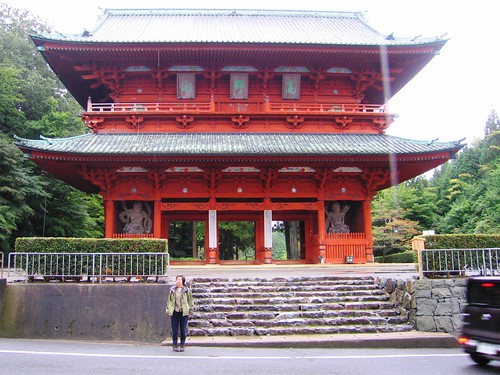
We proceeded through the usual attractions -- Daimon Gate, the Kondo temple, Kongbuji Temple– before returning to the Inn.
We paid 400Y each to enter Kongobuji, the principle temple, where we admired the painted sliding door panels called “fusuma”, the largest rock garden in Japan, the big kitchen, and enjoyed our cup of tea and snack that was included with admission.
Then back to Fukuchi-in at 5PM and into the hot springs bath before dinner. Basically, the routine is wash and rinse yourself, soak in the hot water, then wash off again. I skipped the “wash off again” part. Why bother? Anyway, I had the whole complex to myself so I could not watch how the locals handle the large towel, the small towel, the locker, the robe and sash, regular slippers, rubber slippers, soaps, shampoo, brush, basket, stool, etc. Maybe next visit to Japan.. ;_0 Overall, a most pleasant bath experience.
Dinner was next. We sat in our room our robes (yukata) and the same woman who checked us in started bringing in the vegetarian dinner.
Small hot pot with tofu and mushroom. The pot is actually a piece of non-burnable paper.
Cold cucumber dish
Another cold dish
Rice
Tempura with flavored salt
A cold Asahi Draft (see photo)
A tofu dessert
Overall the food was OK, the beer was cold.
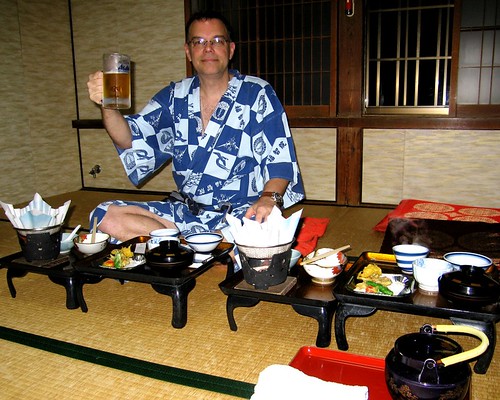
Then back on with our street clothes and a 2 km walk to the Okuno-in area, the famous cemetery containing Kukai’s Mausoleum, where we hope to see a special Buddhist Ceremony. It’s a very, very large cemetery surrounding the KuboDaishi, the Kukai Mausoleum. Kukai is the founder of Pureland Buddhism in Japan.
We were in luck. After cool walk through the cemetery, we arrived at the Hall of Lanterns. We hung out for about 45 minutes. Lots of chanting. No photos or video allowed. I recorded some audio but later accidentally erased it. Bummer.
After a 30 minute walk back to town, we arrived at the Inn only to find that the front gate was locked. So we walked to the nearby Police Station, called the Inn, and everyone had a good laugh.
When we got back to our room, the sleeping mat, quilts and pillows were laid out and we crashed.
To see all the photos from Oct 1, click here.
Prologue: From the moment I accepted the job with Intel in Shanghai, both Sun-Ling and I knew it was only a matter of time before we traveled to Japan. The only decisions to be made were when and where. Our first choice ,first week in May 2006, 7-day public holiday in China, turned out to be a “Golden Week” holiday in Japan as well due to the confluence of 3Japanese National Holidays. So we opted for the fist week in October 2006, a Chinese 7-day public holiday, but not a Japanese holiday.
The “where” for us is usually partially determined by the cost of the to-from transportation. Frequent Flier miles are best. We’ve been know to add or delete an entire country based on its FF mile seat availability. We ended up flying into Fukuoka in southern Japan as it is 50% of the cost to fly to Tokyo, but connected to the Bullet Train (Shinkansen) network.
Journal:
30 September
4:30 PM – Pudong Airport - The start of another Golden Week Holiday. We worked Monday through Saturday and now have 7 days off for the National Day Holiday plus Mid Autumn Festival. Mid Autumn Festival is the Chinese equivalent of a Harvest Moon Festival and by chance this year falls during National Day Holidays. We however, will not be in Shanghai, but will spend the 7 days in Japan. Our flight leaves at 6:00 PM so we have plenty of time – hopefully time for a snack. ;-)
Fukuoka, Japan
Japan is one hour ahead of China, so after a 75 minute flight we landed at 8:30 local time. Quickly passed through the short foreigners immigration line and answered 3 questions at Customs.
“Where do you live?”
“Shanghai.”
“Where did you come from?”
“Shanghai.”
“How long will you be here?”
“7 days.”
Wave of hand.
The Citibank ATM was right at the Customs exit just as our research had indicated. We extracted 50,000 Yen with no problem, used the WC, and caught the 8:55 shuttle bus to the Domestic Terminal. 11 minutes. Easily found the subway entrance. Sun-Ling expertly bought 2 tickets after I pointed out the “English” button and we hopped on the subway at 9:25. We rode 3 stops, 1 stop past the Train Station, and then walked about 3 minutes to the JBB Hotel following the excellent directions on their website.
The young lady at the counter spoke English and seemed to be expecting us. She made copies of our passports, took our 6800 Yen (about $50 US), and gave us the key to room #606. The room was very small, but not the smallest ever. The bathroom had a sink, tub/shower (the shower head on flexible hose), western toilet, toothbrushes, toothpaste, and cups. The sink and shower shared the same faucet which swiveled between sink and tub. Nifty idea. There is a western double bed, no closet (2 hooks on the wall), desk, small fridge, TV, hair dryer, mirror, a small stool (no chair), robes, and slippers. Compact.
After check-in, we immediately headed back out and walked 10 minutes to the train station – past a Lawsons – and after a few inqueries found the right Japan Rail desk to convert our rail pass voucher to an actual 7-day Japan Rail Pass. The yong man behind the counter was quite nice, spoke enough English, made copies of our passports, and gave us our Rail Passes. Then we made 3 “free” train reservations: the next day from Fukuoka (Hakata Station) to Shin Osaka, the day after tomorrow from Shin Osaka to Tokyo, and the final day from Kyoto to Hakata Station. Excellent!
Then we walked west from the station to the Canal District. Saw the local “food stalls” and briefly toured the “red light district”. Young ladies sat on the balconies with a red light florescent light turned on. Wondered back to the hotel by way of the local temple and museum which were closed. The canal area was nice – clear water – and we saw one homeless guy sleeping on a bench. He had a nice quilt, pillow, and looked quite comfy. Arrived back a JBB hotel around 11:15. Ate some of our food stash, showered, relaxed, and crashed.
Impressions of Fukuoka:
Compact, clean, busy, but not crowded.
Easy to get around with an over supply of taxis. Lots of idle taxis near the train station.
Small folding bicycles are popular – just like China. Now I know where they come from. ;-)
Some folks were quite stylishly dressed
SLHOTD: Canal walk
Oct 1, 2006 Fukuoka to Mt Koya
Plan: Train from Fukuoka to Mt. Koya where we will stay one night at a Buddhist Monastery. Mt Koya or Koyasan is associated with Kukai, the Buddhist monk and founder of the Pureland school of Japanese Buddhism on this mountain in the 9th century.
Today, Mt. Koya is still the home of Pureland Buddhist and the 100 or so temples and monasteries onsite take in overnight guests. The standard deal includes a vegetarian dinner and breakfast, and a chance to get up at 5:30 and chant with the monks. We stayed at the Fukuchi-in (Monastery Inn) which also has a hot spring for about $100 USD per person per night. A lot more than we usually pay for accommodation but it’s an experience not to be missed.
Up at 7:00 and out the door at 7:10. After ten minute walk to the Station, we had no trouble boarding the 7:35 train to Shin Osaka Station. For breakfast: pastries bought in Shanghai the day before.
The bullet train was cool. Our reservation was for the non-smoking, silence car. Silence means no talking, no station announcements except for the departure and the arrival at the terminal station. In between stations are not announced. Not even the food cart person says a word.
The seats, a 2x2 arrangement with a rather large aisle, are not 100% comfortable but recline nicely. After making about 10 stops, some at familiar names like Hiroshima and Kobe, we arrived at Shin Osaka on time at 10:20 AM.
I slept for about half the ride. I did however note that the bullet train tracks were usually separated from regular tracks, elevated, with banked turns, and went through many tunnels. After arriving at Shin Osaka, we transferred to the subway and rode to the Osaka Namba Station stop. Here we bought 2 round trip tickets for 5100 Yen each to the Mt. Koya Station which is at the top of a funicular. The tickets also include 2 2-day bus transport passes on Mt Koya. A good package.
The train, light rail, left on time at 11AM. After changing trains in Hashimoto, we seriously started heading uphill. The train struggled up and up a single track, going through 15 or so tunnels (they were numbered) and occasionally stopping for a while at some small station to let the return downhill train pass. The landscape was a mixture of lush bamboo and evergreen forests along with orchards. The area is known for its persimmons.
We arrived at the base of the Mt Koya funicular about 12:40. As it was cloudy, we couldn’t see much during the 5 minute ride up the mountain. It was the usual funicular where the two “inclined trains” pass halfway up the mountain. We then caught the bus – included in our ticket – and arrived at the Fukuchi-in Inn about 1:02 PM.
They were expecting us and a very fit woman of about 40 checked us in, showed us to our room, and gave us a short “guided tour” of the Fukuchi-in Inn. Her English was basic so we were a bit confused about the hot springs bathing protocol since this was our first time. Oh well, we can figure it out later. Finally she brought us tea and a small sweet cake.
Our room was basic. Tatami mats on the floor, a small wardrobe, 2 yukata (robe and sash), safe, low table, cushions, small TV, and a mirror. No chairs or stools.
It was raining, but we headed out anyway to the small Mt Koya downtown area, about a 5 minute walk. After a check with tourist information (not much useful information) and a bit of an argument between us, we caught the bus to Daimon Gate, at the east end of town and began to walk back to the center. Sun-Ling noted that “Daimon” (Big Gate) – would be “DaMen” in Chinese.
Sun-Ling in front of Daimon (big gate) on Mt Koya, Japan. Check out the fierce guardian statues on both sides of gate.
We proceeded through the usual attractions -- Daimon Gate, the Kondo temple, Kongbuji Temple– before returning to the Inn.
We paid 400Y each to enter Kongobuji, the principle temple, where we admired the painted sliding door panels called “fusuma”, the largest rock garden in Japan, the big kitchen, and enjoyed our cup of tea and snack that was included with admission.
Then back to Fukuchi-in at 5PM and into the hot springs bath before dinner. Basically, the routine is wash and rinse yourself, soak in the hot water, then wash off again. I skipped the “wash off again” part. Why bother? Anyway, I had the whole complex to myself so I could not watch how the locals handle the large towel, the small towel, the locker, the robe and sash, regular slippers, rubber slippers, soaps, shampoo, brush, basket, stool, etc. Maybe next visit to Japan.. ;_0 Overall, a most pleasant bath experience.
Dinner was next. We sat in our room our robes (yukata) and the same woman who checked us in started bringing in the vegetarian dinner.
Small hot pot with tofu and mushroom. The pot is actually a piece of non-burnable paper.
Cold cucumber dish
Another cold dish
Rice
Tempura with flavored salt
A cold Asahi Draft (see photo)
A tofu dessert
Overall the food was OK, the beer was cold.
Then back on with our street clothes and a 2 km walk to the Okuno-in area, the famous cemetery containing Kukai’s Mausoleum, where we hope to see a special Buddhist Ceremony. It’s a very, very large cemetery surrounding the KuboDaishi, the Kukai Mausoleum. Kukai is the founder of Pureland Buddhism in Japan.
We were in luck. After cool walk through the cemetery, we arrived at the Hall of Lanterns. We hung out for about 45 minutes. Lots of chanting. No photos or video allowed. I recorded some audio but later accidentally erased it. Bummer.
After a 30 minute walk back to town, we arrived at the Inn only to find that the front gate was locked. So we walked to the nearby Police Station, called the Inn, and everyone had a good laugh.
When we got back to our room, the sleeping mat, quilts and pillows were laid out and we crashed.
To see all the photos from Oct 1, click here.
Wednesday, January 03, 2007
Nanjing, China - 2006
In September, we spent a weekend in Nanjing, China and enjoyed it immensely. If you want to go directly to the photos, click here. Most have good titles and descriptions.
Itinerary:
Saturday
Itinerary:
Saturday
- Purple Hills Scenic Area with Sun Yat-sen's Mausoleum and other nearby attractions
- Fuzimiao and City Wall
Sunday
- Presidential Palace Complex
- Nanjing University
Prologue:
Nanjing was the capital of China during the Republic Period (1912 to 1949) and has loads of interesting things to do and see. I was feeling good about the trip even before it started since we had round trip train tickets (Shanghai/Nanjing - Nanjing/Shanghai) in hand and a hotel booked. It's only recently that one could easily buy round trip train tickets in China. Previously it was part of the travel routine to immediately head to the ticket queue after arriving at your destination to buy the return ticket Now, by paying a small surcharge one can buy both sets of tickets and have them delivered.
Friday, September 15, 2006
The sold-out 16:04 Shanghai to Nanjing train (about 70 RMB each) pulled out around 16:35, over 30 minutes late. Our fellow passengers included one guy with his folding bicycle and another guy with a hand truck full of shoe boxes.
As we passed through Suzhou an attendant came through selling dofu gan (dried tofu) a local specialty. Sun-Ling remembered back to her younger days when she used to ride the train between Hefei and Shanghai. She always looked forward to going through Suzhou as the local dofu gan is quite tasty and not “dry” at all. It’s tofu that has been dried, but then soaked in savory sauces. Yummy! And she added that it seemed they only sold it while going through Suzhou.
Got the usual “Welcome to Suzhou” text message on my cell phone as we approached Suzhou. Do cities do that in the US now?
Arrived at Nanjing Station about 7:20 PM. The new Nanjing Metro is co-located with the train station and we easily found the Metro entrance, bought 2 round, red tokens for 2 RMB each from the automatic machine and rode south 5 stops to Zhong Shan Rd.
After a routine missed turn, we wound up at the Fuchang Hotel, 75 Zhong Shan Rd. This fine art deco hotel was built in 1932; however, now the front facade is obscured by old sycamore trees, and the first floor lobby has been converted into shops.
After first being shown a quiet, back-facing room we opted for a front-facing double with a view of the street for 280 RMB per night, breakfast included. The room had twin beds, frig, safe, electric water heater, TV, closet, reading lights, slippers, desk, chair, toothbrush, and was clean and kept up.
Not too soon for me we headed out to nearby LP-recommended Harry’s Place for pizza and beer. I liked Harry’s Place, not only did they have 20% off on food after 8:30, but also 50% on drinks. The smiling waitress delivered 2 cold pints of Carlsberg, a coconut drink for Sun-Ling, one 9” veggie pizza, one order of home fry chips, and one order of home fry hash browns - all for 92 RMB, about $12 US.
Then back to the hotel to crash.
Saturday September 16, 2006
The plan for the day is Sun Yat-sen’s Mausoleum and Fuzimiao.
Up at 7:30, into the shower, and over to the adjoining Central Hotel for breakfast. It seems that the Fuchang is an annex of the Central and Fuchang guests can use Central’s facilities. Anyway, an excellent buffet breakfast with spreads of Chinese, American, European and Japanese food. I had an omelet, rice soup, cheese, bread, and coffee.
Then about 10 or so we headed out to catch a bus to Sun Yat-sen’s tomb. First let me explain a crucial fact. Sun Yat-sen’s Mandarin Chinese name is Sun Zhong Shan and he is most often referred to a just Zhong Shan. So Sun Yat-sen’s Tomb is also known as Zhong Shan Ling. Sun Yat-sen is acknowledged by most Chinese (even the Communist Party) to be the founder of the modern China and thus every town in China seems to have a Zhong Shan Rd and/or Zhong Shan Park.
After a detour to a local bookstore to buy a city map, we caught bus #9 and arrived a Zhong Shan Ling about 11AM. The clouds were giving way to sun as we bought our 80 RMB combo ticket (4 attractions total) and set out to climb the 392 wide steps up to the Mausoleum. There were many, many, people; locals and tourist who had come out to the green hills (actually called the Purple Hills Scenic Area) to see the tomb of Dr Sun who died in 1925 and was placed in his tomb in 1932. This monument to Dr Sun is wide open, grand, and reminded us of some of the European palace grounds we have visited.
Then we caught the free tram to the Linggu Temple and Pagoda, Beamless hall, and Tai Yan Kai tomb attractions. The pagoda, said to have been designed by an American, had ~240 steps up a spiral staircase to magnificent views of the surrounding hills and back to downtown Nanjing.
We ate lunch at the Pine Pavilion Vegetarian restaurant near Linggu Temple. 36 RMB for 2 bowls of noodle soup and one cold dish. A sign said there has been a vegetarian restaurant on that spot for 500 years.
After a visit to the Sun Yat-sen Museum, we caught bus Y2 to Fuzimiao, an area with a scenic canal, Confucius school, and tons of shops and restaurants. We rented an electric boat – 30 minutes for 25 RMB – and cruised down the canal towards Zhonghua Gate Castle and back. Then walked back to Zhonghua Gate, an impressive part of the old City Wall, and paid our 20 RMB each to wander around. Nanjing has an impressive amount of its old city wall still standing but exploring it will have to wait for another trip. Then back to Fuzimiao, and eventually after much searching had dinner at a Korean restaurant: 87 RMB for 2 beers, a pancake, and a stone bowl. Taxied back to the hotel. Had a long, long, long, wait for hot water in the bathroom. Why? Why? Why? And crashed.
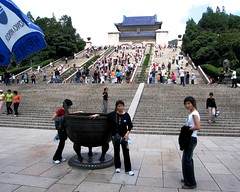
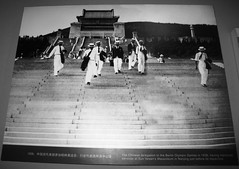
SLHOTD: Zhong Shan Ling. Very impressive with the 392 steps, blue tile roofs, simple design, and gold letters. Note the old photo of "The Chinese delegation to the Berlin Olympic Games in 1936 having memorial services at Sun Yatsen's Mausoleum just before departure."
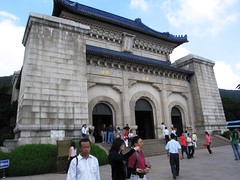
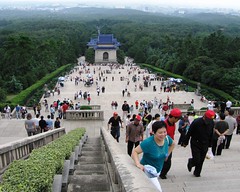
John’s miscellaneous notes on the day:
o Missed a great photo of a mobile bicycle repair shop.
o Got an OK photo of a traditional popcorn vendor with bellows and cannon.
o Roasted chestnuts are in.
oWalked by the full St Paul’s Church while we were searching for a restaurant.
Sunday, September 17, 20
Slept in to 8:00 AM .
Over to the Central for a tasty breakfast: omelet, coffee, youtiao (fried breadsticks), pastries, cake, and a cheese sandwich.
Packed our bags, paid the bill, checked out, and left our bags with the front desk. The total bill was for one night only (280 RMB) due to the hot water incident from the previous night.
We started up Chang Jiang Lu towards the Presidential Palace. We stopped at several Republic Era buildings including the Art Museum, Hanfu Hotel, and Culture Center.
Around the Presidential Palace are a brand new library (huge) and a shopping complex called 1912. We walked 340 degrees around the PP before finding the entrance. This gave us a chance to spot the Hot Café with its Che Guevara mural.
We spent about 3 hours touring the Presidential Palace complex - 40 RMB each. It’s very interesting and most sites are well marked and described in English; and there are several Museums. The art deco buildings in Nanjing are cool. There are several in the PP complex and more in other parts of Nanjing. Sun-Ling wants to return to Nanjing to visit all 60 some of them.
By 3PM we were worn out and headed over to the Tea Station at 1912 for a snack: 1 huge mango ice (see photo), 1 Iced Coffee, Tiramisu, and Chocolate black Forrest Cake (83 RMB).
After sitting for awhile, we caught bus #95 to Nanjing University. After a quick tour of the nearby Drum Tower (5 RMB each) we toured NJU from north to south, including the Ferguson Library. Then headed over to Shanghai Lu for some cheap western eats at the Skyways Bakery: Cheese Sandwich and drink for 18 RMB each. Bought some snacks “to go”, took a taxi back to Fuchang hotel, picked up our bags, and road the Metro 5 stops to the train station. Train T717 pulled out on time at 7:24 PM and the rest of the trip was almost uneventful.
SLHOTD: The old photos in the PP museums.
JHOTD: Watching SL eat her Mango Ice.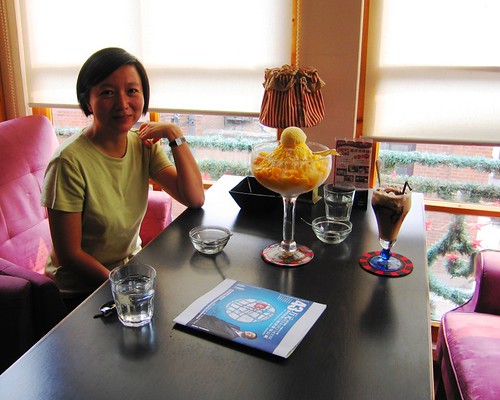
Subscribe to:
Posts (Atom)
Most Recent Post
Croatia: Poreč
From Piran, Slovenia we continued south to Poreč, Croatia. For the straight line distance of 21 miles, we had to take another international ...

Most Popular Posts of Last 30 Days
-
After 3 days in Val Gardena, we changed bases to Dobbiaco, to the northeast. We decided on Dobbiaco over Cortina D'Ampezzo, because ther...
-
This is our last day in the Dolomites. John's cold is not getting better and the weather is cloudy, so we decided to go joyriding on our...
-
After Aix and Luberon, I had learned to reset my expectations for France. Maybe as a result, I rather like Avignon. In fact, it seems more ...
-
Udine is one of those quintessential Italian towns that we love. They make me want to just settle in for a while. The Alpe-Adria trail goes ...
-
When Indigo airlines canceled our Colombo-Hyderabad flight, we took India and Pakistan off our itinerary. Considering we are in the 10th yea...
-
Lake Bohinj is quiet and serene. We based ourselves in Stara Fuzina, north of the lake. The village still has a traditional feel; that is, y...
-
There was just one last hike we had planned for Val Gardena - Mount Pic Summit at 2363 meters. We first took the bus to the next village up ...


