When traveling we pretty much drink and eat as locals do although as vegetarians we don't eat meat or fish. In particular I take my cues from cleanly dressed ladies when it comes to selecting food stalls, restaurants, or street vendors. The fact we are vegetarians and we travel with Ciproflaxin for major episodes and a Chinese medication for minor upsets makes us pretty liberal with food and drink.
For water, we drink tap water from the hotel if the locals say they drink the town's tap water, and we almost always use tap water for brushing teeth. When tap water is considered non-potable, we get or boil our own water (as in China), get filtered water from hotel (pretty rare), fill from hotel's water cooler (not very often), or buy water as a last resort in order to cut down on the amount plastic we use. Our family mule not only goes through a lot of feed, he can drink a lot of water each day. When we do buy water, we buy the largest size bottle we can comfortably handle. For this trip, we have been able to get 5-liter bottles in Ecuador and 5-liter bags in Colombia, which we decant into our two, 1-liter nalgene bottles: one wide-mouth and one narrow-mouth. We also carry 2 small metal mugs.
Our strategy has worked pretty well in general, except John got parasites in Burma which he got over by himself. In fact he did not even know he had them until well after he was all better. I got parasites in Nepal which took me a while to diagnose and had to take medication.
This trip we have been doing well so far. We have been mostly over 2000m (7000ft). It is either sunny and dry or cold and wet, not very conducive for bacteria growth. Besides, boiling water does not help as much, since water boils at lower temperatures. We can even tell just from drinking boiling hot coffee which seems to be "ready to drink". Even at lower altitudes I suspect people are pretty apt to use pesticides. Lastly the population density in the New World is not same as the Old World; that makes everything better.

Subscribe to:
Post Comments (Atom)
Most Recent Post
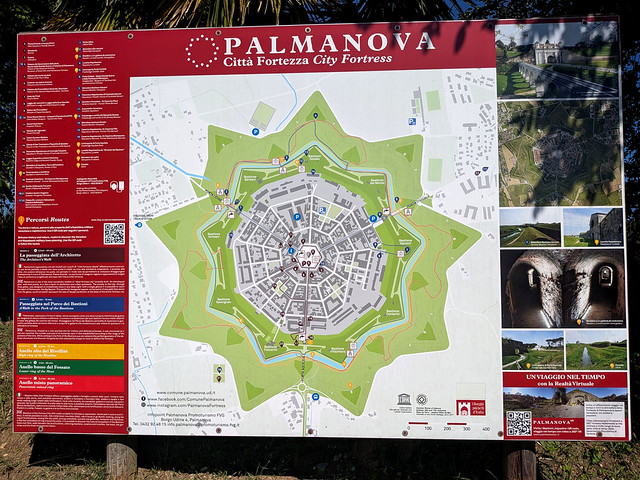
Italy: Palmanova
From Udine, we also made a quick trip by train to Palmanova UNESCO 2017. Palmanova looks really cool on the map (see first photo below). It...
Most Popular Posts of Last 30 Days
-
When Indigo airlines canceled our Colombo-Hyderabad flight, we took India and Pakistan off our itinerary. Considering we are in the 10th yea...
-
After a "Melaka City Tour" route on local bus #17 we arrived at Melaka Sentral Bus Terminal and in a few minutes - no time for a t...
-
After 3 days in Val Gardena, we changed bases to Dobbiaco, to the northeast. We decided on Dobbiaco over Cortina D'Ampezzo, because ther...
-
This is our last day in the Dolomites. John's cold is not getting better and the weather is cloudy, so we decided to go joyriding on our...
-
The second day we took a bus to Passo Sella to ride the Forcella del Sassolungo gondola (~2180m - ~2680m), nicknamed the "Coffin Lift...
-
On our day of departure from Bolzano, the weather was better, so we went for a planned hike. The idea is to head up Val di Funes by (valley)...
-
There was just one last hike we had planned for Val Gardena - Mount Pic Summit at 2363 meters. We first took the bus to the next village up ...


3 comments:
Thanks. I was curious.
You got parasites in Nepal?! I never heard about this.
Take care!
Yi
@Yi, I must have mentioned in passing or hotmail could have eaten it up. I was having upsets on and off in Nepal and China. I think it was the water, not any particular food I ate. When we returned to the US, I could not sleep, jetlagged and stomach cramping. I researched again and had a positive diagnosis of Giardiasis. After a dose of four gigantic Tinidazole pills, I was all better the next day.
Post a Comment