Search This Blog

Wednesday, March 18, 2026

Tunis: Punic Kerkouane

Kerkouane is not a photogenic site, but was inscribed by UNESCO in 1985. Since it was abandoned after the First Punic War, it is the only Phoenician/Punic site remaining today that is unadulterated by the Romans.

The site is well preserved enough to make out what could have been the prototypes of later Roman houses; center courtyard and finished floor. Furthermore each house has a bathtub and basin; an obviously prosperous sophisticated civilization, destroyed by Rome.

It was not a waste of time as I had half expected. I even had an epiphany - Roman won the Punic Wars over the Semitic speaking people, but in the end adopted Judeo Christianity, a Semitic religion. Maybe that's the reason Christianity never seemed congruent with Europe to me, because it is really Roman at its core: conquest, subjugation, and hierarchy, as the new Punic War wages on.

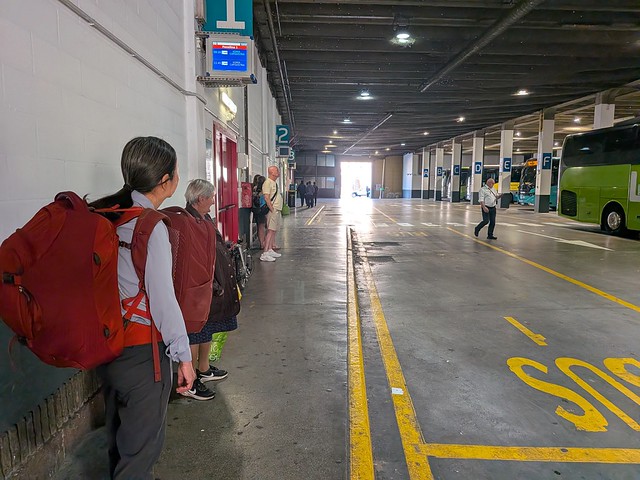
The first stage of our visit to Kerkouane is a 2-hour louage (long-distance shared taxi/van) ride from the Bab Aliwa Louage Station in Tunis to El Haouaria. Below is the busy Bab Aliwa Station.
Bab Aliwa Louage Station - Daytrip to the Ruins of the Punic City of Kerkouane  - near Kelibia, Tunisia

We passed Rades Olympic Stadium.
Rades Olympic Stadium  - Daytrip to the Ruins of the Punic City of Kerkouane  - near Kelibia, Tunisia

In El Haouaria, we took a brief look around town, before taking a taxi to the Kerkouane site turnoff. I was surprised to see an old cinema with a mural of Charlie Chapline as "The Tramp". And we walked towards the famous caves for a look at the Mediterranean Sea.
The Cinema-Teatro in El Haouaria - Daytrip to the Ruins of the Punic City of Kerkouane  - near Kelibia, Tunisia

View to Zembra Island from El Haouaria  - Daytrip to the Ruins of the Punic City of Kerkouane  - near Kelibia, Tunisia

A glimpse of the old ways from the taxi.
Daytrip to the Ruins of the Punic City of Kerkouane  - near Kelibia, Tunisia

From the turnoff, it was a 3km walk to the site.
Daytrip to the Ruins of the Punic City of Kerkouane  - near Kelibia, Tunisia

The compact site museum (below). Check out the downspout ornament (2nd below) and Aerial Photo (3rd)
Daytrip to the Ruins of the Punic City of Kerkouane  - near Kelibia, Tunisia

Downspout Ornament  - Kerkouane  Site Museum - Daytrip to the Ruins of the Punic City of Kerkouane  - near Kelibia, Tunisia

Aerial Photo - Kerkouane  Site Museum - Daytrip to the Ruins of the Punic City of Kerkouane  - near Kelibia, Tunisia

As one enters the site, there is an excellent map with a marked route and a legend.
Site Map with Legend - Daytrip to the Ruins of the Punic City of Kerkouane  - near Kelibia, Tunisia

Our first stop is the "Sign of the Tanit House". Check out the terraza-like floors and the "Tanit Sign" (close up is 2nd below)
Sign of the Tanit House - Ruins of the Punic City of Kerkouane  - near Kelibia, Tunisia

Sign of the Tanit House - Ruins of the Punic City of Kerkouane  - near Kelibia, Tunisia

The house also has a distinctive, and very cool IMO, red "hip bath" that seems to be in every house throughout the site.
Hip Bath - Ruins of the Punic City of Kerkouane  - near Kelibia, Tunisia

House Doorway.
House Doorway - Ruins of the Punic City of Kerkouane  - near Kelibia, Tunisia

The so-called "House with a Courtyard and Peristyle" located right at the water's edge, and its hip bath.
House with a Courtyard and Peristyle - Ruins of the Punic City of Kerkouane  - near Kelibia, Tunisia

Hip Bath - Ruins of the Punic City of Kerkouane  - near Kelibia, Tunisia

One of the two Public Squares in Kerkouane.
Public Square -  Ruins of the Punic City of Kerkouane  - near Kelibia, Tunisia

"House of the Priest" signage and another hip bath. ;-}
House of the Priest Sign - Ruins of the Punic City of Kerkouane  - near Kelibia, Tunisia

Hip Bath - Daytrip to the Ruins of the Punic City of Kerkouane  - near Kelibia, Tunisia

Remnants of the City Wall.
City Wall - Ruins of the Punic City of Kerkouane  - near Kelibia, Tunisia

Ruins of the Punic City of Kerkouane  - near Kelibia, Tunisia

And we taxi to the Kelibia Louage Station, and take a louage back to Tunis; 2 hours on bumpy roads.
Returning to Tunis after a Daytrip to the Ruins of the Punic City of Kerkouane  - near Kelibia, Tunisia

Daytrip to the Ruins of the Punic City of Kerkouane  - near Kelibia, Tunisia

Returning to Tunis after a Daytrip to the Ruins of the Punic City of Kerkouane  - near Kelibia, Tunisia

Video: Our Louage Hits Some Traffic Returning to Tunis.
Video: Our Louage Hits Some Traffic Returning to Tunis after a Daytrip to the Ruins of the Punic City of Kerkouane  - near Kelibia, Tunisia

360 video of the Kerkouane site.
Daytrip to the Ruins of the Punic City of Kerkouane  - near Kelibia, Tunisia

Tuesday, March 17, 2026

Tunisia: Day Tripping From Tunis on the Train

After visiting Dougga and Bulla Regia as stopovers, we found ourselves with an extra day. We went joy riding on the suburban train, though it was operating at a reduced schedule for Ramadan. We first had a short walk in the Boukernine National Park, happened upon millions of wildflowers on the hill, and great views back north to Tunis, and below to Hamman-Lif

Daytrip to Hammam-Lif and Rades - Tunis, Tunisia

Daytrip to Hammam-Lif and Rades - Tunis, Tunisia

Daytrip to Hammam-Lif and Rades - Tunis, Tunisia

We then looked around in Hamman-Lif, which had been a settlement since Punic times, and was the "Saint Tropez" of Tunisia during colonial time, still evidenced by the Casino on the waterfront. Next, we stopped in Rades, another ancient settlement, home of a large number of colonial villas. There is even a church. At the time of independence, 10% of the population were European. Now I see they weren't all living in Tunis proper.

Hamman-Lif Casino, Beach, and Outdoor Market
Hammam-Lif Casino - Daytrip to Hammam-Lif and Rades - Tunis, Tunisia

Daytrip to Hammam-Lif and Rades - Tunis, Tunisia

Hammam-Lif Beach - Daytrip to Hammam-Lif and Rades - Tunis, Tunisia

Outdoor Market in Hammam-Lif - Daytrip to Hammam-Lif and Rades - Tunis, Tunisia

Video: Our train from Hammam-Lif to Rades pulls into the Station.
Video: Waiting at Hamman-Lif Station for the train to Rades - Daytrip to Hammam-Lif and Rades - Tunis, Tunisia

Rades City Hall
Daytrip to Hammam-Lif and Rades - Tunis, Tunisia

Abandoned Catholic Church in Rades.
Abandoned Catholic Church in Rades - Daytrip to Hammam-Lif and Rades - Tunis, Tunisia

Colonial Villa in Rades
Colonial Villa in Rades - Daytrip to Hammam-Lif and Rades - Tunis, Tunisia

The Scene at Rades Train Station.
Daytrip to Hammam-Lif and Rades - Tunis, Tunisia

Monday, March 16, 2026

Tunisia: Bardo Museum

The last time we came to Tunisia, the Bardo Museum was closed because of political tension. Though the overall political situation may now be worse, Tunisia is open for tourists and so is the Bardo, home of the largest and finest Roman mosaic collection in the world. It was the first thing on our Tunis agenda.

While there is no doubt as to the size of the Bardo collection, we both thought the museum at El Jem may have an even finer collection. Nevertheless Tunisia certainly has the finest Roman mosaics in the world.

On our first full day in Tunis we headed straight to the Bardo Museum by suburban train.
Gare De Tunis - Tunis, Tunisia

Gare De Tunis - Tunis, Tunisia

The Bardo Museum - Tunis, Tunisia

The Islands Mosaic is a Roman mosaic found in the ancient city of Ammaedara, Tunisia. It represents islands and cities of the Mediterranean Sea of the 3rd or 4th century CE.
The Roman "Islands Mosaic" -   Bardo Museum - Tunis, Tunisia

Typical room in the museum = mosaics from floor to ceiling, on all four sides.
The Bardo Museum - Tunis, Tunisia

Marine Mosaics Room.
Marine Mosaic Room - The Bardo Museum - Tunis, Tunisia

Marine Mosaic Room - The Bardo Museum - Tunis, Tunisia

Roman Mosaic showing the personification of the "Days of the Week" with Saturn (Saturday) in the middle.
Roman Mosaic showing the  Personification of the Days of the Week with Saturn in the Middle - The Bardo Museum - Tunis, Tunisia

Roman Mosaic of "Virgil and the Muses". It is the most famous piece in the Bardo; that is, the Mona Lisa of the Bardo. ;-)
Roman Mosaic of Virgil and the Muses - The Bardo Museum - Tunis, Tunisia

Previously, the Bardo building was a sumptuous palace, thus many of the exhibition rooms are exquisite themselves.
The Bardo Museum - Tunis, Tunisia

The Bardo Museum - Tunis, Tunisia

The Bardo Museum - Tunis, Tunisia

This mosaic of a typical country farm villa caught our attention.
Roman Mosaic of a Typical Country Farm Villa - The Bardo Museum - Tunis, Tunisia

Portion of a Roman Mosaic of Three Cyclopes: Brontes, Steropes and Pyracmon Forging Lightning. Found at the Dougga Archaeological Site.
Roman Mosaic of Three Cyclopes: Brontes, Steropes and Pyracmon Forging Lightning - The Bardo Museum - Tunis, Tunisia

Birds.
Birds - The Bardo Museum - Tunis, Tunisia

More Maritime Scenes including Ulysses Tied to the Mast of his Ship to Resist the Sirens.
More Maritime Schences including Ulysses Tied to the Mast of his Ship to Resist the Sirens (Lower Right)  - The Bardo Museum - Tunis, Tunisia

Ulysses Tied to the Mast of his Ship to Resist the Sirens - The Bardo Museum - Tunis, Tunisia

The Triumph of Dionysus of Acholla
Roman Mosaic - The Triumph of Dionysus of Acholla - The Bardo Museum - Tunis, Tunisia

Video: Roman Mosaic of Many Fish in the Sea
Video: Roman Mosaic of Many Fish in the Sea - The Bardo Museum - Tunis, Tunisia

Most Recent Post

Tunis: Punic Kerkouane

Kerkouane is not a photogenic site, but was inscribed by UNESCO in 1985. Since it was abandoned after the First Punic War, it is the only Ph...

Most Popular Posts of Last 30 Days