Julius Caesar granted the ancient town of Trieste, then known as Tergeste, the status of a Roman colony around 46 BC. In the Medieval Period, the name gradually evolved from Tergeste to Trieste.
Trieste was the one and only port city of the Habsburgs, and it was a free port 1719–1891 during which huge quantities of commodities came from the colonies and plantations. Trieste prospered. Even today, 40% of all green coffee entering Italy comes through Trieste; illy caffè is from Trieste.
Thus, Trieste has a lot of grand buildings, public and private. One of them we visited was the house of Pasquale Revoltella who was instrumental to the Suez Canal. Though the canal did not open until 1869, it greatly benefited Trieste.
Another grand building was Miramare Castle, built for Maximilian I around 1860, and where he accepted the crown of Emperor of Mexico in 1864. Three years later he was executed in Mexico 1867. However the content of the Palace fared much better, surviving displacements during both WWI and WWII. In fact, Miramare is a rare European palace that remains intact. Did they have some nice stuff!!! We rarely pay to go inside palaces anymore. We happened to have bought the tourist pass for Trieste that included Miramare - dumb luck.
Another legacy we experienced was the Opicina Tramway which opened in 1902. It climbs from sea level up to 329 meters in Opicina on the Karst plateau in 5 km. The climbing part is a steep 26% where the tram is hitched to a funicular "sled" pushed from behind. Quite a unique system!
We arrived at a lively Trieste Centrale Station after a short train ride from Udine.


In the evenings folks stroll and hang out at the Grande Canal, Piazza Unità, and the adjacent pier to watch cruise ships depart.


Also on Piazza Unità is the Palazzo del Governo with its shimmering mosaics.

One day we rode the Hop On Hop Off bus to Miramare Castle and Gardens, passing the cement beaches that make up the so-called Trieste Riviera (first below) on the way.


The Museo Revoltella Gallery of Modern Art was filled with memorable works including an excellent painting of the Suez Canal (1st below) as Revoltella was an enthusiast. Compare his painting to my 2022 photo from the airplane when we flew from Alexandria, Egypt to Amman, Jordan.


And: The Last Leaf (1910) by Giovanni Giani. Grandmother's Story (1875) by Pietro Saltini. Lady Walking with her Dog (1878) by Giuseppe De Nittis. After First Communion (1892) by Carl Frithjof Smith.


Here are photos and short videos from our journey to Opicina and back on the historic tram. And the great view from the Opicina Obelisk Belvedere (3rd below).


We passed the ruins of the Roman Theatre (1st Below), and the Roman Arch (2nd below) on the way up to the Cathedral (3rd and 4th below) on Monte Saint Guisto.


Monte St Guiuto was the site of the Roman City. There are the ruins of the forum and a basilica (with the existing Cathedral behind). Not to mention a great view down to Triest.

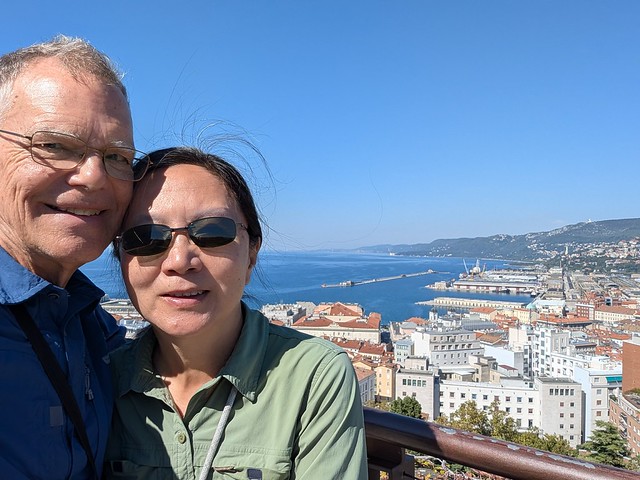

There is also a War Memorial (1st below), Habsburg fort (2nd below), and an Archaeological Museum of Roman Mosaics and Inscriptions (3rd).

 br>

From San Guisto we rode the Autobus Elettrico to Trieste Centrale, then walked up Via Commercial to check out the Liberty Style Art Nouveau Architecture with Casa Pietro Valdoni (3rd and 4th below declared the winner.


Bonus Museo Revoltella works. Beethoven (1900) by Lionello Balestrieri. The Blue Veil (Il Velo Blu) by Triestino Painter Glauco Cambon (1875–1930).


Thanks for reaching the end of this long post! - sun-ling and john


No comments:
Post a Comment